

Beyond the Smile: Psychological Safety is More Than Being Nice
Psychological safety, the idea that every member of the team is encouraged to be their authentic self without worrying about ostracism or punishment, is often discussed as something leaders should create over time. In practice, it is something that leaders and managers signal in real time—especially under pressure. The moments that matter most are rarely planned: a missed deadline, an unexpected challenge, a public disagreement, a mistake surfacing late in the process. What happens next determines whether people speak up again.
Psychological safety is not “being nice” and accountability is not “being mean”
When people feel safe to ask questions, raise concerns, admit mistakes, and share ideas, without fear of embarrassment or payback, that is psychological safety. It’s not about staying in a comfort zone; it’s about learning and results. And it matters for performance. Without psychological safety, teams may appear agreeable but remain silent. Problems stay hidden, errors repeat, and people avoid ownership.
Accountability is widely misunderstood and often gets treated as punishment. Yet, the more accurate definition is this: an internal commitment to do everything you can to uphold standards of excellence and contribute to the team’s goals.
Typically, there are two versions of accountability that people may encounter at work:
- Punitive accountability: focused on blame and negative consequences for mistakes or failures.
- Growth-oriented accountability: an empowering sense of ownership that restores dignity by helping people own their part in a larger system and get better.
Many of these moments are governed by speed. Under pressure, leaders default to fast, automatic reactions—interrupting, correcting, defending decisions, or jumping straight to solutions. While efficient on the surface, these responses quietly teach people which risks are safe to take and which are not. This is the time where it can feel like there’s a tradeoff between psychological safety and accountability, and, while these two ideas are interrelated, they are far from contradictory.
The pause that changes everything
In times of stress, most of us operate in what psychologists describe as fast, reactive thinking. This mode prioritizes certainty, control, and immediate answers. In the workplace, it often sounds like: “Why didn’t this come up sooner?” or “We already decided this.” or “Just fix it.”
These responses are rarely intended to silence others. Yet, they do. They signal that speaking up creates friction, embarrassment, or extra work. Over time, people adapt by sharing less, especially when it comes to questions, dissenting views, or early warnings.
If leaders want to be more intentional, it helps to identify situations where reactions matter most:
- When someone admits a mistake
- When a concern challenges a prior decision
- When emotions rise during conflict
- When progress is slower than expected
Psychological safety strengthens when leaders intentionally slow down. Reflective responses create space for meaning, curiosity, and learning—without lowering standards or avoiding accountability.
A brief pause before responding can shift an interaction from reactive to reflective. This pause is not about being passive or soft; it is about choosing a response that keeps people engaged in the work. In practice, slowing down allows leaders to:
- Listen for what might be incomplete, unclear, or emerging
- Separate the problem from the person raising it
- Respond in a way that invites more information rather than less
The difference is subtle. However, the impact is not.
These moments are inflection points. A single response can move a team toward learning—or push it into anxiety or silence.
What does psychologically safe accountability look like?
So, how do you hold someone accountable in a psychologically safe way? One helpful starting point is staying calm. Calm does not mean apathetic. It means you can address the issue clearly, without blame, and without escalating fear. Then:
- Set guidelines and boundaries: To encourage creativity, leaders need to define expectations. Clarity gives people stability, so they can take calculated risks without fearing consequences.
- Name the gap early: Don’t wait until frustration builds. Address issues early and focus on observable behavior and impact, not personality or intent.
- Make it a learning conversation: Move the discussion from “who is at fault?” to “what are we learning and what changes next time?” This keeps standards high while building capability.
- Follow through with support and a clear next step: Accountability means the person leaves knowing what “success” looks like, what will change, and what support is available.
If that still feels abstract, a few small language shifts can make a big difference.
Simple response swaps leaders can practice
Rather than memorizing scripts, leaders can focus on replacing instinctive reactions with curiosity-driven ones. Take the time during your pause to identify what your immediate reaction would have been, and then instead swap it for a more thoughtful approach.
- Replace judgment with exploration: “What led to this?” instead of “How did this happen?”
- Replace immediacy with clarity: “Let’s slow this down—what do we know for sure?” instead of “How are you going to fix this?”
- Replace defense with inquiry: “What are we missing?” instead of “Here’s why we chose this.”
These questions still demonstrate the need to solve problems and improve, keeping accountability in the forefront, while reducing interpersonal risk. In this space, a team can feel safe to innovate and bring forward any concerns before they become larger problems.
Moving teams toward the Learning Zone
Teams tend to operate in predictable patterns: comfort, anxiety, apathy, or learning. Leaders rarely announce these zones; however, they reinforce them through everyday responses. When leaders pause, listen, and ask forward-focused questions, they make it safer for others to think out loud.
Over time, this shifts the team toward the Learning Zone: challenged, supported, and willing to surface issues early—when they are easiest to address.
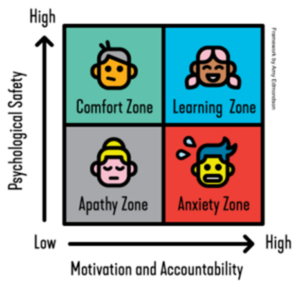
Comfort Zone: Safe yet unchallenged
Learning Zone: Challenged and supported
Apathy Zone: Neither safe nor driven
Anxiety Zone: Pressured but fearful
While it’s impossible to stay 100% of the time in the Learning Zone, the goal is to stay there as much as possible and let it still be your target when not.
Pressure is not the enemy of psychological safety—unchecked pressure is. High standards, deadlines, and real consequences are what make work meaningful. However, when pressure pushes teams into speed without reflection, they slip out of the Learning Zone and into anxiety or defensiveness. Slowing down under pressure is what keeps teams in the Learning Zone and prevents challenges from becoming fear.
Psychological safety doesn’t begin with trust-building exercises or sweeping culture statements. It begins with how leaders respond in the moments they feel most pressure to move fast.
How have you encouraged psychological safety in your organization? Was there a time you had to adjust your approach to maintain a psychologically safe environment?
Leave a comment below, send us an email, or follow us on LinkedIn.
Leave A Comment